CANUS/Company
CANUSTechnologies.
An Australian owner-operator of AI factories. The facts, in one place.
01The facts
01 / 05
What CANUSis.
- Category
- AI Factory as a Service. One customer type, one product, one invoice: rent per IT-kW per month, power at cost. We never touch the tenant's software.
- Product
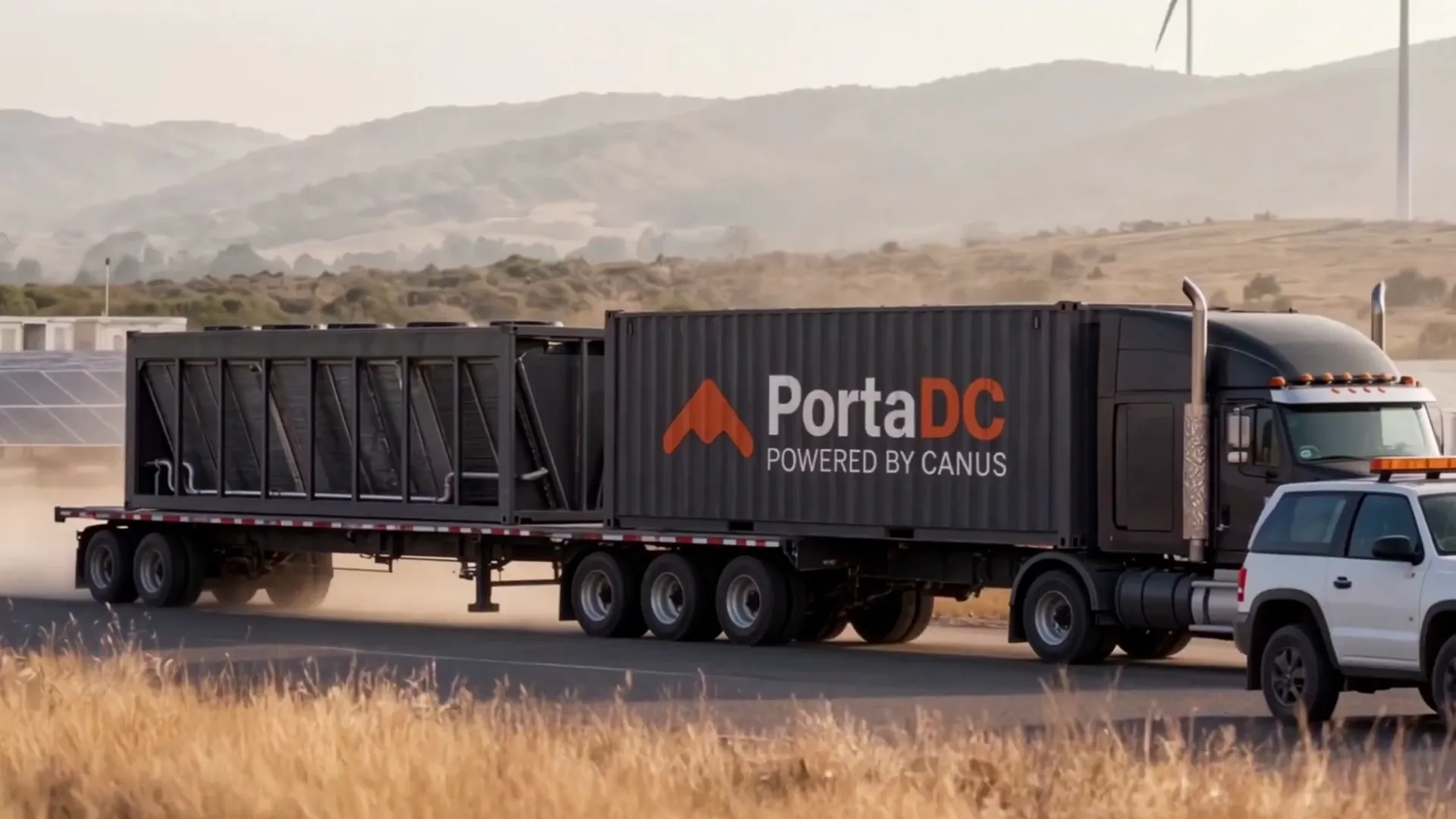
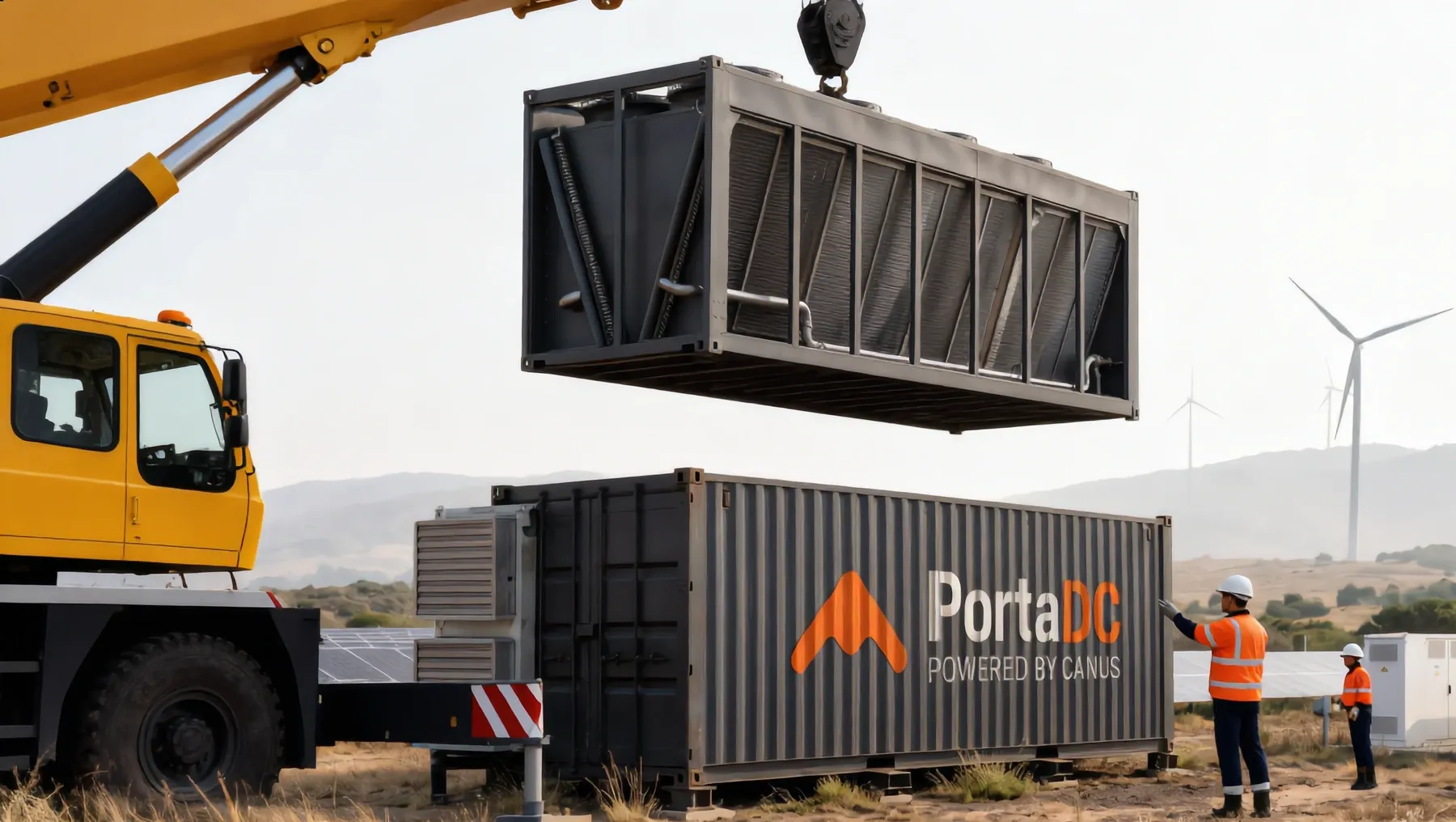
- PortaDC™. A factory-built, liquid-cooled AI facility in two hulls, 450 kW to 1.2 MW IT: PortaDC20 (3 to 5 high-density racks) and PortaDC40 (8 to 12 standard, hybrid and storage racks). Built and tested in the factory, craned onto a pad. Three tiers of one engine: Pulse, Surge and Forge.
- The lease
- Firm to the tenant, flexible to the host. Three numbers: a firm floor the host cannot cut, an always-on cushion held at the boundary, and a contracted flexible band for Surge tenants only. Pulse tenants have a band of zero.
- Systems
- Solar-Sponge™ plans the cushion. FrontierGate™ executes it at the host boundary in milliseconds. LARUS AI™ records electricity in and heat out in one signed operating record.
- The platform
- Repeatable 450 kW building blocks. Every pod is metered for electricity in and heat out from factory test onward, and LARUS AI™ carries that operating record through every hour of service. Four pods fill the first LV bay at 1.8 MW, a site builds to ten pods and 4.5 MW IT (about 5.45 MW input) within the host's accepted import capacity, and sites run as one 22.5 MW+ fleet under one agreement and one record.
- Sites
- Solar-and-battery farms and industrial premises with an existing connection and fibre. Existing connections first, so no new grid works sit on the critical path.
- Jurisdiction
- CANUS Technologies Pty Ltd, Australia. ACN 698 333 158.
- Team
- Two co-founders: power origination and critical power infrastructure; hyperscale OT and infrastructure architecture. Engineering, contractor and compliance roster disclosed under NDA.
Last updated: 6 november 2026
Built to the standard.Delivered to the record.
Every pod is engineered, metered, tested and documented to the same Australian standards a metro hall is held to.
01
Australian Electrical & Switchboard Compliance
Engineered and pre-fitted in Sydney to AS/NZS 3000 and AS/NZS 61439 standards, with type-tested 415 V switchboard assemblies and arc-fault protection.
02
Revenue-Grade Boundary Metering
Revenue-grade electrical and thermal metering across every pod boundary for transparent tenant billing and host settlement.
03
Environmental & Acoustic Standards
Closed-loop liquid cooling with no evaporative water after fill, engineered for regional Australian acoustic and bushfire site envelopes.
04
Factory Acceptance & Site Commissioning
Every pod passes witnessed factory acceptance testing before it ships and site acceptance testing before handover. Engineering packs and test documentation are provided to customers and host partners under NDA.
Built to the standard.Delivered to the record.
What we publish,and what we don't.
- 01
Specifications
Pod capacities, cooling envelopes and economics on this site are indicative. Final figures are set by configuration and site and confirmed in writing before any order.
- 02
Confidentiality
How the boundary controller, the scheduler and the operating record work is confidential. What a pod delivers is metered and shown to the tenant, the host and the lender.
- 03
Filings
Three Australian provisional patent applications filed, covering the independent verification of AI compute capacity, its continuous verification in operation, and its conversion into settlement-grade assurance.
Directanswers.
A complete AI facility in a two-module hull: PortaDC20 (20 ft, 3 to 5 high-density liquid racks at 80 to 130+ kW) or PortaDC40 (40 ft, 8 to 12 standard, hybrid and storage racks at 35 to 65 kW), with direct-to-chip liquid cooling, power distribution and controls below and heat rejection on the roof. 450 kW of IT load per block, 1.10 to 1.21 design PUE. It is built and tested in a factory, trucked to a connected site and craned onto a pad. Target: powered racks 120 days from order.
Connected capacity. We own the pod through a project company and lease the capacity to one AI cloud per pod. One invoice: rent per IT-kW per month, power passed through at cost. We never touch the tenant's software.
They already have a connection and spare capacity behind the meter, so there is no connection queue and no metro tariff. Renewable and hybrid tariffs are passed through at cost under transparent site schedules, shared under NDA. The sites are fenced, monitored switchyards.
Yes, always. Racks from 35 to 130+ kW slide in and plug into the cooling loop, so your hardware, your warranties and your token revenue stay yours. Forge racks run 80 to 130 kW.
Every lease has a firm floor the host cannot cut, an always-on cushion held at the boundary, and a contracted flexible band. Surge tenants carry a 25 to 40% band and shape it with their own orchestration against a power-budget signal. Pulse tenants have a band of zero and are never trimmed.
Coolant runs straight to cold plates on every GPU and CPU and carries the heat to a dry cooler on the roof. Supply coolant is held at or below 35 °C at a 45 °C design ambient, with a 50 °C survival margin. The loop is closed: no evaporative water after the first fill.
Solar-Sponge™ plans the cushion around the solar day. FrontierGate™ executes it at the host boundary in milliseconds, so the host gets its headroom and the tenant's firm floor never moves. LARUS AI™ records electricity in and heat out in one signed operating record that the tenant, the host and the lender read.
We do. CANUS owns, monitors and maintains every pod around the clock and meters every watt in and every unit of heat out. You see what you use and pay only for that.
Target rent per IT-kW-month, power passed through at cost: Pulse US$165 to 172 (A$235 to 245), about US$238 all-in at full 24/7 draw and about US$213 at a 65% average draw, against Sydney metro at about US$270: 12 to 21% under. Surge and Forge are on the pod page. An enquiry does not quote a price or reserve a pod.
Add a pod. Pads are laid out for four; the next pod lands beside the first, shares the connection and joins the same lease. A new pad at a new site connects by fibre and runs as part of the same fleet, on the same record.
Three founding seats: a controls and OT engineer in final discussions, and a senior ML systems engineer and a site delivery lead open to apply. All in Sydney, all with founding-team equity. The careers page has the full seats.
Writeto us.
Free scoping, no commitment. Tell us the customers, the planned capacity, the site, the timing and your part in the build. A named person replies within one business day; your scoping note follows within five working days.
Up next
Patents→