When an independent cloud builds with partners rather than on its own balance sheet, the question a lender asks changes shape. It is no longer only whether the operator is good for the money. It is whether the demand behind the deployment is committed enough, and the delivery conditions clear enough, for capital to move on them.
There is no shortage of AI demand. There is a shortage of AI demand that a credit committee can lend against. The difference is not enthusiasm or pipeline. It is the specific form the demand takes on paper: who has committed, to what capacity, for how long, at what price, and what has to be true before the first payment is due. This piece sets out what the market has actually financed over the last three years, and what those transactions had in common.
01
Contracted, not forecast
The clearest lesson of the period is the gap between merchant and committed capacity. On-demand H100 rental prices fell from a 2023 peak of around 8 dollars per GPU hour to roughly 2 to 3 dollars by late 2025 as supply arrived1. Committed pricing moved on a different track, and the two have since decoupled: spot capacity is a commodity, contracted capacity is an asset. Lenders priced this early. Every large GPU-backed facility to date has been secured on contracted revenue rather than expected utilisation.
CoreWeave's 2.3 billion dollar facility in August 2023 was collateralised, meaning secured, by its NVIDIA chips and customer contracts2. Its 7.5 billion dollar facility in May 2024, led by Blackstone and Magnetar, was raised expressly to build capacity for existing contracts with named customers3. In March 2026 the company closed an 8.5 billion dollar delayed-draw facility rated A3 by Moody's and A (low) by DBRS, described as the first investment-grade financing secured by high-performance computing infrastructure and an associated customer contract4. What was rated was the facility. What made it investment grade was the contracted revenue and the delivered hardware securing it.
What was rated was the facility. What made it investment grade was the contract behind it.
02
Who the customer is
Because the contract carries the credit, the identity of the counterparty carries the project. Microsoft accounted for 62 percent of CoreWeave's 2024 revenue5. OpenAI signed for up to 11.9 billion dollars of CoreWeave capacity in March 2025 and expanded the relationship twice within the year6. Nebius agreed to supply Microsoft with dedicated infrastructure worth about 17.4 billion dollars through 2031, and said plainly that it would fund the build from contract-based cash flows and debt7.
Where the tenant's own credit is not enough, the market has found a third party to stand behind it. In August 2025 Google agreed to backstop, that is to guarantee, 1.8 billion dollars of Fluidstack's lease obligations at TeraWulf's Lake Mariner campus in New York, taking warrants in return; the arrangement was extended within days as a further lease was signed89. In September 2025 Google backstopped 1.4 billion dollars of Fluidstack's obligations at Cipher Mining's Barber Lake site in Texas on the same pattern10. In each case the credit enhancement, not the site, is what made the debt possible. Concentration is both the feature and the risk: one counterparty's promise carries the build, and that counterparty's exit is the tail.
03
The asset and its life
The second question a lender asks is how long the collateral is worth anything. The industry has not agreed. Amazon shortened the useful life of a subset of its servers from six years to five from January 2025, citing the pace of AI development, at a cost of about 700 million dollars to that year's operating income11. Meta moved the other way in the same month, extending its servers to five and a half years and reducing its 2025 depreciation by around 2.9 billion dollars12. In November 2025 the investor Michael Burry argued that hyperscalers were understating depreciation by a cumulative 176 billion dollars over 2026 to 2028; NVIDIA has said its customers see four to six years of useful service from its hardware13.
For a financing, the useful-life debate becomes a question of tenor, the length of the loan. The contract term, the asset's economic life and the loan's maturity have to be arranged so that the debt is repaid from contracted cash flow inside the period the equipment is demonstrably worth running. Residual value is not a plan.
04
Delivery conditions
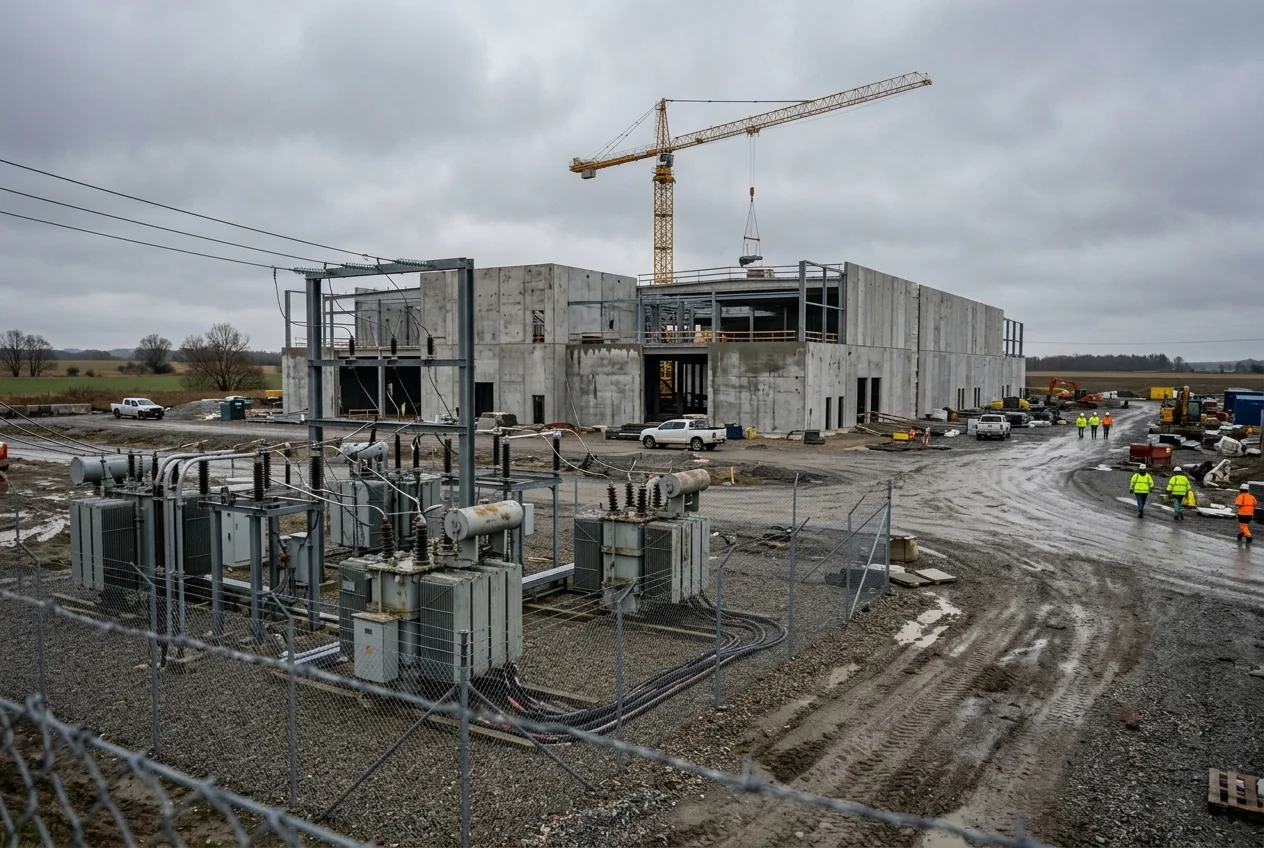
The third element is the one least discussed outside the deal team, and the one where most projects actually fail. Money is released against conditions. In a delayed-draw structure the borrower draws as assets are delivered, installed and put into service under the contract; CoreWeave's 2026 facility, for instance, allowed initial borrowing of about 7.5 billion dollars with the balance available as the underlying assets stabilised4. Securitised debt typically becomes available only after construction, when the asset is operating and generating lease cash flow14.
Every one of those conditions has a delivery event underneath it. Equipment arrived. Equipment installed. Power switched on at the authorised level. Capacity performing against the customer's requirements. Customer acceptance. Insurance in force. Between the signing of the contract and the satisfaction of the last condition, the project is at its most exposed, and the quality of the paperwork is the whole of the protection. A credible project is one where the delivery conditions were written before equipment was ordered, in terms every party can read, and where something independent of the parties can say whether they have been met.
05
What a credible project looks like
Put together, the projects that have been financed share a shape. A named customer with a committed term and a fixed payment obligation. Delivery requirements written into the order, not inferred from a specification sheet. Power approvals kept distinct, so that a connection offer is never mistaken for permission to energise. Equipment and installation contracts aligned to the customer's requirements and the customer's dates. A record of what was delivered that the lender, the insurer and the customer can each read and each question. And a plan for the next block that does not depend on the first one being refinanced.
CANUS does not provide, arrange or guarantee finance. The programme brings those commitments and conditions into one place before equipment is ordered, coordinates the partners who have to meet them, and gives the lender independent results when each phase is delivered, to assess under its own policy.
Sources
- 1
SiliconData, "H100 rental price over time".
www.silicondata.com/blog/h100-rental-price-over-time - 2
Reuters, "CoreWeave raises $2.3 billion in debt collateralized by Nvidia chips" (3 August 2023).
www.reuters.com/technology/coreweave-raises-23-billion-debt-collateralized-by-nvidia-chips-2023-08-03/ - 3
CoreWeave, "CoreWeave Secures $7.5 Billion Debt Financing Facility led by Blackstone and Magnetar" (17 May 2024).
investors.coreweave.com/news/news-details/2024/CoreWeave-Secures-7-5-Billion-Debt-Financing-Facility-led-by-Blackstone-and-Magnetar/default.aspx - 4
CoreWeave via Business Wire, "CoreWeave Closes Landmark $8.5 Billion Financing Facility, Achieving First Investment-Grade Rated GPU-backed Financing" (30 March 2026).
www.businesswire.com/news/home/20260330529766/en/CoreWeave-Closes-Landmark-%248.5-Billion-Financing-Facility-Achieving-First-Investment-Grade-Rated-GPU-backed-Financing - 5
CoreWeave, Inc., Form S-1 registration statement (March 2025), US Securities and Exchange Commission, EDGAR.
www.sec.gov/cgi-bin/browse-edgar?action=getcompany&CIK=0001769628&type=S-1&dateb=&owner=include&count=40 - 6
CoreWeave, "CoreWeave Expands Agreement with OpenAI by up to $6.5B" (25 September 2025).
investors.coreweave.com/news/news-details/2025/CoreWeave-Expands-Agreement-with-OpenAI-by-up-to-6-5B/default.aspx - 7
Nebius Group, "Nebius announces multi-billion dollar agreement with Microsoft for AI infrastructure" (8 September 2025).
nebius.com/newsroom/nebius-announces-multi-billion-dollar-agreement-with-microsoft-for-ai-infrastructure - 8
TeraWulf, "TeraWulf Signs 200 MW 10-Year AI Hosting Agreements with Fluidstack" (14 August 2025).
investors.terawulf.com/news-events/press-releases/detail/112/terawulf-signs-200-mw-10-year-ai-hosting-agreements-with-fluidstack - 9
TeraWulf, "TeraWulf Announces Fluidstack Expansion with 160 MW CB-5 Lease at Lake Mariner" (18 August 2025).
investors.terawulf.com/news-events/press-releases/detail/114/terawulf-announces-fluidstack-expansion-with-160-mw-cb-5-lease-at-lake-mariner - 10
Cipher Mining, "Cipher Mining Signs 168 MW 10-Year AI Hosting Agreement with Fluidstack" (25 September 2025).
www.globenewswire.com/news-release/2025/09/25/3156107/0/en/Cipher-Mining-Signs-168-MW-10-Year-AI-Hosting-Agreement-with-Fluidstack.html - 11
Amazon.com, Inc., Form 10-K for the fiscal year ended 31 December 2024, note on property and equipment useful lives, EDGAR.
www.sec.gov/cgi-bin/browse-edgar?action=getcompany&CIK=0001018724&type=10-K&dateb=&owner=include&count=40 - 12
Meta Platforms, Inc., Form 10-K for the fiscal year ended 31 December 2024, note on useful lives of servers and network assets, EDGAR.
www.sec.gov/cgi-bin/browse-edgar?action=getcompany&CIK=0001326801&type=10-K&dateb=&owner=include&count=40 - 13
CNBC, "Michael Burry's depreciation argument and the AI trade" (14 November 2025).
www.cnbc.com/2025/11/14/ai-gpu-depreciation-coreweave-nvidia-michael-burry.html - 14
Morgan Stanley Research, "Bridging the Data Center Financing Gap" (2025).
www.morganstanley.com/content/dam/msdotcom/en/assets/pdfs/Research_Bridging-Data-Center-Gap.pdf
Public sources, cited as read at the time of writing. CANUS is not affiliated with any company named in these articles, and none of the transactions described involved CANUS.