CANUS/Technology / Solar-Sponge™
More compute when solar is abundant.Less demand when the site needs power.
Proprietary thermal-mass buffering and workload-shaping architecture that absorbs high-output renewable generation windows and rides through transient cloud or tariff events without evaporative water or grid stress.
01In operation
01 / 04
Solar-Sponge™Solar-Synced Scheduling & Thermal Buffer
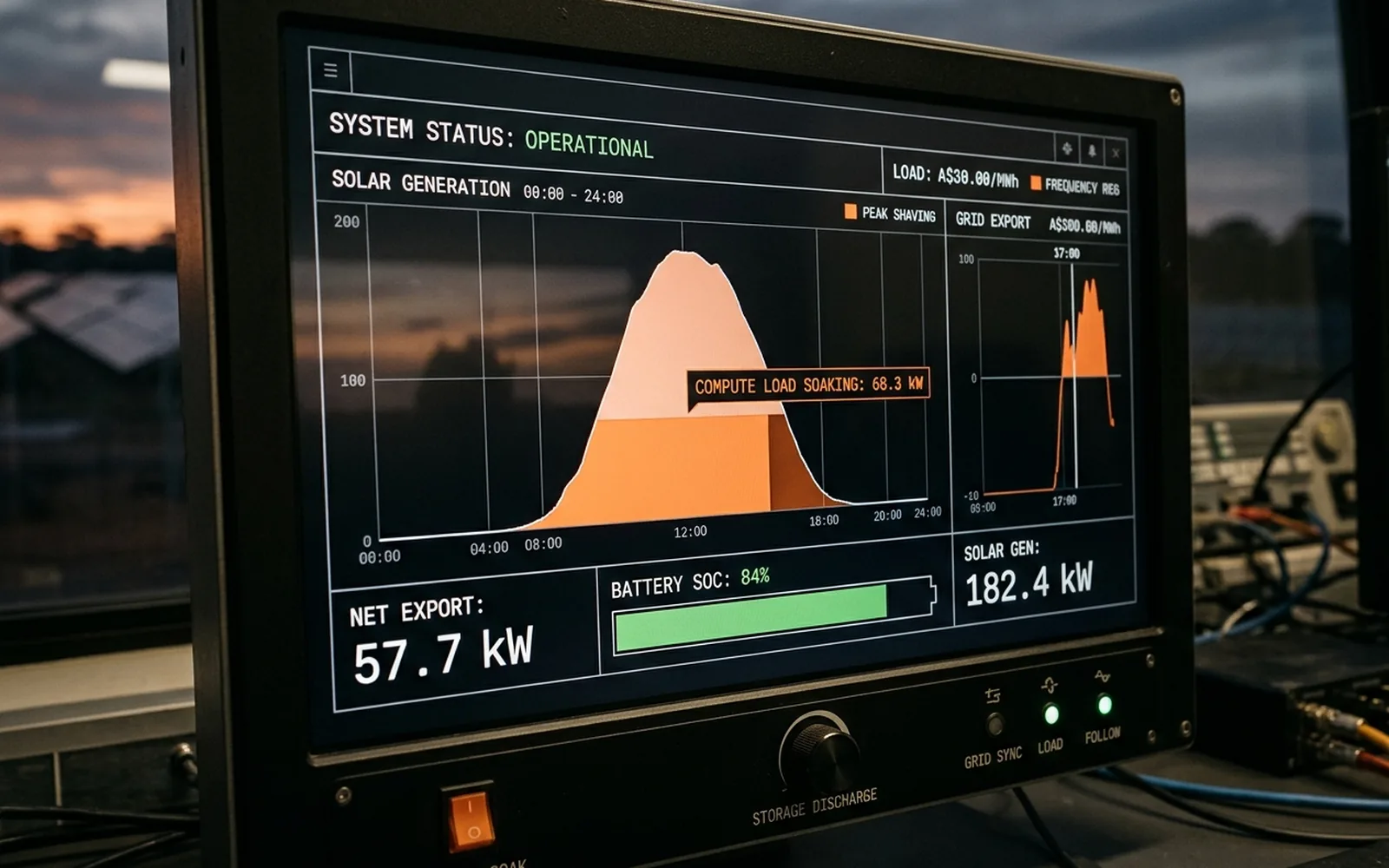
Modelled 24-hour operating day (900 kW cluster · 2 × 450 kW pods · 1 MW boundary)
Synchronised: cluster demand above · cushion state below
12:00 · Full compute on daytime solar · cushion charging
Cluster demand
900kW
Token output
100%
Cushion charge
84%
00:00–08:00 & 20:00–24:00
Overnight grid & battery dispatch: hybrid tariff passed through at cost under the site schedule
08:00–17:00
Daytime behind-the-meter solar window: full compute, cushion charging on renewable output
17:00–20:00 · when called
Host call: the cushion is released at the boundary; Surge tenants shape their own contracted band, Pulse untouched
- 450 kW → 1.2 MW
- Per Pod, Two Hulls
- 22.5 MW+
- Per Campus, Run as One Fleet
- 120 days
- Target from Order to Powered Racks
- -12–21%
- Under Sydney Metro, All-in
- 0 L
- Evaporative Cooling Water
Solar-Sponge™Solar-Synced Scheduling & Thermal Buffer
What it does.What it means.
- 01
The power ledger
Power at cost, one line
What it does
Direct behind-the-meter renewable and hybrid tariffs passed through under transparent site schedules (shared under NDA), delivering 12 to 21% lower all-in compute cost than Sydney metro colocation. Power is passed through at cost, not marked up.
What it means
Rent and power sit on separate lines of one invoice, so a tenant can trace each, and the solar behind it is recorded hour by hour.
- 02
The cushion, planned
Hour by hour
What it does
During midday solar, Solar-Sponge™ plans the flexible band around the solar day. It plans the cushion hour by hour; FrontierGate™ executes it at the boundary.
What it means
The host's evening headroom comes from the cushion, never from the tenant's firm floor. The GPUs never notice.
- 03
Surge only: the tenant-authorised flexible band
25 to 40%, contracted, tenant-run
What it does
Tenant-authorised and Surge only: when the host calls, Solar-Sponge™ publishes a power-budget signal inside the contracted 25 to 40% band and the tenant's own orchestration answers it, shaping its batch, fine-tuning and prefill queues however it chooses. Pulse tenants have a band of zero and are never trimmed.
What it means
The retention a Surge tenant holds through a called event is its own target, set by its orchestration, not a CANUS promise. The host meets its flexibility obligation; the tenant's software is never touched.
Indetail.
The power ledger
Passed through at cost, separate from the rent · site tariffs shared under NDA
Daytime solar
Behind the meter · 08:00–17:00 · site schedule under NDA
Direct
Blended 24 h
Solar + overnight grid & battery dispatch · passed through at cost
Hybrid
Metro hall
Retail grid mix plus network charges, not passed through at cost
Tariff
All-in, Pulse
21% under
Against Sydney metro colocation, all-in
Carbon
Scope 2, matched
Interval-matched proof of the solar behind the tokens
All-in cost vs the hall
Target rent + power at cost · US$ per IT-kW-month · you bring the GPUs · 900 kW cluster
PortaDC Surge™
~US$182 / IT-kW / mo
Sydney metro, all-in
~US$270 / IT-kW / mo
Under Sydney metro
33%
Against the hall, per year · 900 kW
US$0.95M
Indicative figures, confirmed in each lease. Site tariffs are shared under NDA. You own the GPUs on both sides; the gap is the rent and the power.
Deploy
Tell us the workload.We'll bring the pod.
A short conversation about what you run, where your customers are and when you need it.
Up next
LARUS AI™→